Published by:
CGP EDU Academic Team
Published on: September 13, 2026
A conducting sphere of radius 10 cm is charged with 10 µC. Another uncharged sphere of radius 20 cm is allowed to touch it for some time. After that if the sphere are separated, then surface density of charged on the spheres will be in the ratio of:
Text Solution
Verified by ExpertsThe correct answer is:
C
Radius of conducting sphere 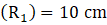
charge on the conducting sphere 
and radius of uncharged sphere 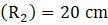
For a spherical conductor, the density of charge is proportional to its radius. Therefore ratio of density of charges of the spheres will be  .
.
Prepare Smarter with CGP Edu
Get practice questions, solutions, and test series in one place.
Write a Review
Share your experience with this question and solution.
Commentary
Send your comment, doubt, correction, or feedback to admin.
Similar Questions
Explore conceptually related problems
The capacity of a parallel plate condenser is . When a glass plate is placed between the plates of…
A capacitor is charged by using a battery which is then disconnected. A dielectric slab is then sli…
The energy of a charged capacitor is given by the expression ( $\alpha$ = charge on the conductor a…
The capacity of a condenser is $4 \times 10^{-6}$ farad and its potential is 100 volts . The energy…
The insulated spheres of radii $R_1$ and $R_2$ having charges $Q_1$ and $Q_2$ respectively are conn…
In a charged capacitor, the energy resides